




Ask the AI Tutor
Need help with Painting? Ask our AI Tutor!
AI Tutor - Lucy
Connecting with Tutor...
Please wait while we establish connection
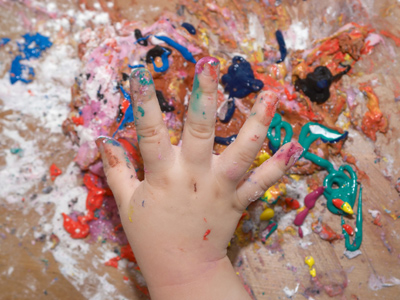
Young children like to finger paint but it is also taught as a recognised skill.
Painting
Painting helps you explore colour, texture, and mood. Practise mixing colours, controlling your brush, and choosing techniques to create pictures that look bold, soft, or realistic.
1 .
Not all painting is done with brushes. What else can be used?
Fingers
Cameras
Washing machines
Printers
Young children like to finger paint, but it is also taught as a recognised skill!
2 .
A verdaille is a painting done mainly or entirely in which colour?
Blue
Yellow
Red
Green
Verdaille began with in 12th century stained glass made for Cistercian monasteries
3 .
What do we call a painting which is painted directly onto wet plaster?
A fiasco
A frasco
A frisco
A fresco
Many ancient frescos were painted in churches and cathedrals
4 .
What is the technique in which small dots of colour are used to make an image?
Dottiness
Pointillism
Dabbing
Speckling
Famous Pointillists include Georges Seurat and Paul Signac
5 .
Which of the following is not a paint colour?
Ochre
Cerulean
Velvet
Magenta
Ochre is a yellow, cerulean is blue and magenta is a pinky-red
6 .
Some paintings use realistic images to create the optical illusion that the objects are three dimensional. What is this called?
Tip of Well
Trowel and wheel
Triumph of oil
Trompe-l'œil
The words are French for 'deceive the eye' and some are exceptionally good
7 .
What do we call a watery layering of paint used as a background?
A wipe
A clean
A scrub
A wash
A wash is good for a sky or a background, with other detail painted on afterwards
8 .
Jackson Pollock painted many of his works by throwing paint at a large canvas. What was this known as?
Vigorous Painting
Action Painting
Messy Painting
Moving Painting
His work was vibrant and full of colour
9 .
Some artists use small, air-operated tools which spray various media including ink and dye, but most often paint. What are they called?
Breeze brushes
Wind painters
Oxygen painters
Airbrushes
Airbrushes can give a flat, uniform finish to a large area
10 .
Which word describes the gradual blending of one colour hue to another, usually moving tints and shades from light to dark?
Umbro
Ombré
Hambel
Timbre
Ombré painting makes for an interesting and dramatic background to a piece
Our Social Circles




**Unlimited Quizzes Await You! 🚀**
Hey there, quiz champ! 🌟 You've already tackled today's free questions.
Ready for more?
Ready for more?
🔓 Unlock UNLIMITED Quizzes and challenge yourself every day. But that's
not all...
not all...
🔥 As a Subscriber you can join our thrilling "Daily Streak" against other
quizzers. Try to win a coveted spot on our Hall of Fame Page.
quizzers. Try to win a coveted spot on our Hall of Fame Page.
Don't miss out! Join us now and keep the fun rolling. 🎉
**Unlimited Quizzes Await You! 🚀**
Hey there, quiz champ! 🌟 You've already tackled today's free questions. Ready for more?
🔓 Unlock UNLIMITED Quizzes and challenge yourself every day. But that's not all...
🔥 As a Subscriber you can join our thrilling "Daily Streak" against other quizzers. Try to win a coveted spot on our Hall of Fame Page.
Don't miss out! Join us now and keep the fun rolling. 🎉
© Copyright 2016-2026 - Education Quizzes
Work Innovate Ltd - Design | Development |
Marketing
