




Ask the AI Tutor
Need help with Ancient Greek and Roman Art? Ask our AI Tutor!
AI Tutor - Lucy
Connecting with Tutor...
Please wait while we establish connection
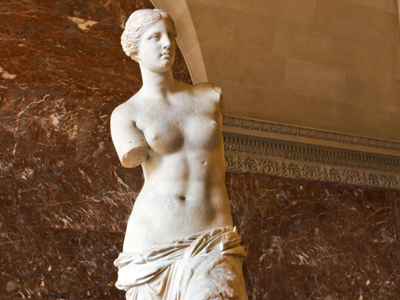
'The Aphrodite of Melos' is better known as 'The Venus de Milo'.
Ancient Greek and Roman Art
Explore Ancient Greek and Roman art, from idealised sculpture to grand buildings. Discover how artists used materials, patterns and design choices to tell stories and influence later art.
1 .
The first and greatest period of classical art began in Greece about the middle of the 5th century BC. What had the Greeks learned how to do?
How to make marks in marble
How to produce comprehensive sketch books
How to work for longer periods of time
How to represent the human form accurately and easily
They were, at first, mainly interested in portraying gods rather than humans
2 .
The Greeks had plenty of marble and used it prolifically. Which aspect of it did not please them?
Its softness
Its strength
Its smoothness
Its cold whiteness
They overcame this by painting statues to make them look more lifelike
3 .
Early Greek vases were predominately painted in which colour?
Blue
Brown
White
Green
Stick-like figures of men and animals were fitted into an over-all geometric pattern
4 .
In 146 BC, what happened to entwine the creative development of both Greece and Rome?
Letters were sent from Greek philosophers to Roman artists
Artists travelled from one region to another
The Roman Emperor married the Queen of Greece
The Romans invaded Greece
"Greece, conquered, led her conqueror captive" is a poet's way of expressing the triumph of Greek over Roman culture
5 .
After the conquest, how did wealthy Romans decorate their lavish villas?
With paintings done by Russian artists
With paintings done by French artists
With paintings done by Roman soldiers
With paintings done by Greek artists
Roman artists may have also been employed, but only if their influences were Greek!
6 .
The Persian invasion (490-479 BC) of Greece destroyed many beautiful buildings. What was the greatest rebuilding triumph?
The Greek Tavernas
The Athenian Acropolis
The Roman Baths
The Basilica
The Parthenon, the Erechtheum, and other beautiful buildings, can still be seen in part today
7 .
What activity had a great deal of influence over both Greek and Roman sculptors?
Athletics
Sleeping
Kissing
Painting
Myron sculpted the famous 'Discobolus', or 'Discus Thrower'. His 'Doryphorus', or 'Spear Bearer' was believed to follow the true proportions of the human body perfectly
8 .
Phidas was a famous Greek sculptor. Some of his work now resides in the British Museum, and is known as what?
The Earnest Sculptor
The Elphin Sculptures
The Ebor Tributes
The Elgin Marbles
Lord Elgin brought them from Athens in 1801-12
9 .
The 'Aphrodite of Melos' is a beautiful sculpture housed in the Louvre in Paris. What is it now known as?
Vesuvius de Milan
Venice De Mellow
Venus de Milo
Ventricle de Mindful
Nothing is known of its sculptor. Experts date it between 200 and 100 BC
10 .
Another distinctive sculpture in the Louvre depicts the windswept goddess of Victory who gave her name to a sports company. What is it called?
Nike
Adidas
Dunlop
Jack Wills
It is also known as 'Winged Victory'. The Greek government gave it to the Louvre in exchange for a frieze that once adorned a temple on the island



**Unlimited Quizzes Await You! 🚀**
Hey there, quiz champ! 🌟 You've already tackled today's free questions.
Ready for more?
Ready for more?
🔓 Unlock UNLIMITED Quizzes and challenge yourself every day. But that's
not all...
not all...
🔥 As a Subscriber you can join our thrilling "Daily Streak" against other
quizzers. Try to win a coveted spot on our Hall of Fame Page.
quizzers. Try to win a coveted spot on our Hall of Fame Page.
Don't miss out! Join us now and keep the fun rolling. 🎉
**Unlimited Quizzes Await You! 🚀**
Hey there, quiz champ! 🌟 You've already tackled today's free questions. Ready for more?
🔓 Unlock UNLIMITED Quizzes and challenge yourself every day. But that's not all...
🔥 As a Subscriber you can join our thrilling "Daily Streak" against other quizzers. Try to win a coveted spot on our Hall of Fame Page.
Don't miss out! Join us now and keep the fun rolling. 🎉




© Copyright 2016-2026 - Education Quizzes
Work Innovate Ltd - Design | Development |
Marketing
