




Ask the AI Tutor
Need help with Experimentation? Ask our AI Tutor!
AI Tutor - Lucy
Connecting with Tutor...
Please wait while we establish connection
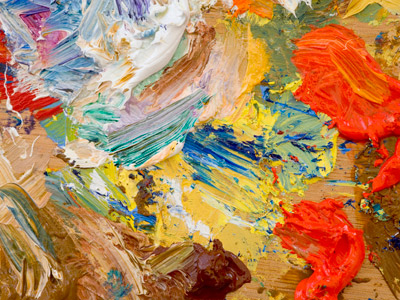
When mixing paints it's a good idea to make a note of the quantities used.
Experimentation
Artists improve faster when they test ideas on purpose. Explore how experimenting with materials and methods helps you discover new effects, refine choices, and build confident creative decisions.
1 .
Colour, line, shape, form, space, value and texture are all known as what?
Shorter words about art
The elements of art
Names of different media
Paperwork and forms about art
Experimenting with any of these elements in artwork can change the whole look of a piece
2 .
How could you change the thickness and density of dry materials such as pencils and charcoal?
By using smaller pieces
By changing the quality of the paper used
By laying down a wash first
By adjusting movements and pressure
Changing the movement of hand, wrist, elbow and arm and increasing and decreasing pressure will all affect the lines made
3 .
How might an artist organise an experimenting session?
By taking a photograph of all the materials they intend to use
With labelled swatches ordered in a sketchbook
By reading a book on experimentation
By writing down what they think about experiments
It's useful to note which combinations of media were used, especially if the outcomes might need to be repeated in the future
4 .
Why is it important to experiment with different media when creating art?
Because you never know what might happen
Because the results could be really interesting
Because the best ideas sometimes happen by accident
All of the above
Putting different media together, or using a familiar medium in a new way, could result in finishes and effects which take your project in a new direction
5 .
When experimenting with colour mixing, what should you always try to do?
Use a smaller palette
Stick to two colours only
Use very fine brushes
Keep accurate notes of the quantities of each colour used
Notes will help you mix the same colours in future, without having to start the experimentations all over again!
6 .
Which of the following combinations could you try to achieve a speckled effect?
Crayons and felt tips
Pencils and masking tape
Acrylic paint and card
Watercolour paint and sea salt
Throwing the salt across wet paint will soak up paint in small areas, creating a speckled effect
7 .
When making rubbings, what could change the outcome?
Making two rubbings in the same place
Using different media and paper thickness
Using the same wax crayon each time
Taping down the paper first
Some media will give crisper rubbings than others. Paper thickness will also affect the finished rubbing
8 .
What is the name for a piece of artwork which uses more than one medium?
Muddled media
Mixed media
Messed media
Mashed media
Mixed media has always been popular amongst artists and some of the results are incredible
9 .
What sort of medium would resist a watercolour wash?
Wax crayons or candles
Pencils
Charcoal
Marker pens
The watercolour paint cannot 'sit' on top of the wax and is instead 'resisted'
10 .
When experimenting with a variety of elements and media for a project, some artists collect inspirations and ideas on what?
On a mood board
On an emotion block
On a feeling slab
On a senses plate
Mood boards are used by artists and designers to collate ideas, experiments and thoughts for a project



**Unlimited Quizzes Await You! 🚀**
Hey there, quiz champ! 🌟 You've already tackled today's free questions.
Ready for more?
Ready for more?
🔓 Unlock UNLIMITED Quizzes and challenge yourself every day. But that's
not all...
not all...
🔥 As a Subscriber you can join our thrilling "Daily Streak" against other
quizzers. Try to win a coveted spot on our Hall of Fame Page.
quizzers. Try to win a coveted spot on our Hall of Fame Page.
Don't miss out! Join us now and keep the fun rolling. 🎉
**Unlimited Quizzes Await You! 🚀**
Hey there, quiz champ! 🌟 You've already tackled today's free questions. Ready for more?
🔓 Unlock UNLIMITED Quizzes and challenge yourself every day. But that's not all...
🔥 As a Subscriber you can join our thrilling "Daily Streak" against other quizzers. Try to win a coveted spot on our Hall of Fame Page.
Don't miss out! Join us now and keep the fun rolling. 🎉




© Copyright 2016-2026 - Education Quizzes
Work Innovate Ltd - Design | Development |
Marketing
