




Ask the AI Tutor
Need help with Romanticism? Ask our AI Tutor!
AI Tutor - Lucy
Connecting with Tutor...
Please wait while we establish connection
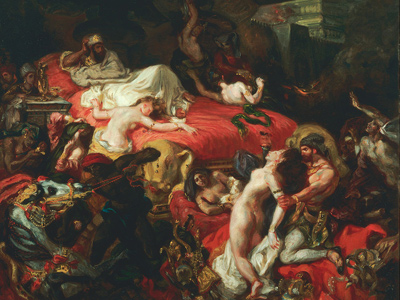
'The Death of Sardanapalus' is a painting by the Romantic artist Eugène Delacroix.
Romanticism
Romanticism art is full of drama, imagination and big feelings. Explore how artists used subject matter and style to create powerful messages, then test yourself below.
1 .
Romanticism flourished, in part, due to a manufacturing turning point which was commonly known as what?
The Factory Overhaul
The Mechanical Uprising
The Processing Growth
The Industrial Revolution
The Industrial Revolution was the transition to new manufacturing processes in the period from about 1760 to sometime between 1820 and 1840
2 .
The Romantic movement placed new emphasis on emotions never really explored in mainstream art before. Which emotions were they?
Joy and elation
Contentedness and peacefulness
Horror and terror
Reflection and thoughtfulness
The movement emphasised intense emotion as an authentic source of aesthetic experience and many artists used these emotions as inspiration
3 .
The Romantic Artists rebelled against the traditional rules surrounding art, maintaining instead that art should come from where?
A text book on art
The artist's imagination
Copied paintings from other artists
A religious perspective only
The movement believed the artist should be inspired by their own emotions, with as little interference as possible from "artificial" rules dictating what a work should consist of
4 .
Romantics tended to believe that it was mentally and morally healthy to have a close connection with what?
God
Man-made objects
Rule books
Nature
The Romantic artists surrounded themselves with nature and were distrustful of the man-made world around them
5 .
Which war happened early in the Romantic period and may have influenced the art?
The Crusades
The Second World War
The French Revolution
The War of the Roses
The French Revolution took place from 1789 to 1799, followed by the Napoleonic Wars until 1815
6 .
In which particular discipline did Romanticism first show itself?
Landscape painting
Religious portraits
Abstract works
Sketches of pets
From as early as the 1760s, British artists began to turn to wilder landscapes and storms, and Gothic architecture
7 .
Which art form remained largely unaffected by Romanticism?
Painting
Photography
Printing
Sculpture
This may well have been because sculpting in marble, which was popular at the time, does not lend itself well to the dramatic gestures required by Romanticism
8 .
One trend during the period, was for very large apocalyptic historical paintings. What does this mean?
Paintings which showed many different historical events all happening at once
Paintings showing disaster or extreme natural events with a historical context
Paintings which were so large they could not be displayed
Paintings which only showed positive events from history
Some of these paintings were so dramatic and emotive that they came with a warning!
9 .
Charles Baudelaire famously summed up the entire movement by saying which of the following:
Romanticism is something from the soul, neither real nor fake
Romanticism pours out of every artist, should they let it
Romanticism is the pinnacle of art - there will be no way back from this
Romanticism is precisely situated neither in choice of subject nor exact truth, but in the way of feeling
Most artists of the time would have agreed that the movement was mainly about feelings and emotion, not processes and rules
10 .
Which period came after Romanticism?
Post-romanticism
New Romanticism
Further Romanticism
After Romanticism
This period came in the late nineteenth and early twentieth century



**Unlimited Quizzes Await You! 🚀**
Hey there, quiz champ! 🌟 You've already tackled today's free questions.
Ready for more?
Ready for more?
🔓 Unlock UNLIMITED Quizzes and challenge yourself every day. But that's
not all...
not all...
🔥 As a Subscriber you can join our thrilling "Daily Streak" against other
quizzers. Try to win a coveted spot on our Hall of Fame Page.
quizzers. Try to win a coveted spot on our Hall of Fame Page.
Don't miss out! Join us now and keep the fun rolling. 🎉
**Unlimited Quizzes Await You! 🚀**
Hey there, quiz champ! 🌟 You've already tackled today's free questions. Ready for more?
🔓 Unlock UNLIMITED Quizzes and challenge yourself every day. But that's not all...
🔥 As a Subscriber you can join our thrilling "Daily Streak" against other quizzers. Try to win a coveted spot on our Hall of Fame Page.
Don't miss out! Join us now and keep the fun rolling. 🎉




© Copyright 2016-2026 - Education Quizzes
Work Innovate Ltd - Design | Development |
Marketing
