




Ask the AI Tutor
Need help with The First World War 05? Ask our AI Tutor!
AI Tutor - Lucy
Connecting with Tutor...
Please wait while we establish connection
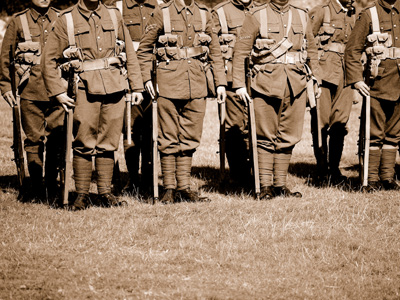
Conscription began during the First World War.
The First World War 05
Discover how the entry of the United States in 1917 brought fresh troops and supplies, helping exhausted Allied forces turn the tide against Germany in World War One.
1 .
Love of your country and a duty to fight for it is known as what?
Partiality
Paternalism
Patriotism
Patristics
In the early part of the war, many young men rushed to join up to fight for their country
2 .
Conscription began in Britain at what age?
16
18
20
21
As the losses of men increased and the number of volunteers dropped, it was necessary to force people to join up to fight
3 .
What were sometimes handed out as a symbol of cowardice?
Black spots
White feathers
White handkerchiefs
Yellow scarves
Young men not in uniform were targeted as it was assumed they had been too cowardly to volunteer
4 .
Britain claimed victory in which naval battle of 1916?
Copenhagen
Dungeness
Jutland
Spitsbergen
The only major sea battle of the entire war
5 .
Jutland is part of which country?
Belgium
Denmark
Netherlands
Sweden
The lower part of the Jutland peninsula was part of Germany and was where the German naval fleet was stationed. The British lost more ships and more sailors than the Germans but claimed victory as it made the German fleet stay in harbour for the rest of the war, apart from a few brief actions
6 .
Wilfred Owen and Rupert Brooke were killed in the war - both famous .......
musicians
painters
poets
sportsmen
They wrote poems inspired by their war experiences
7 .
Which passenger liner was sunk by a U-boat torpedo in 1916?
Carpathia
Lusitania
Mauretania
Titanic
It happened off the coast of Ireland
8 .
The Lusitania incident helped to bring which country into the war?
New Zealand
Republic of Ireland
South Africa
USA
USA fought with the Allies against Germany
9 .
Who was the U.S. President at that time?
Theodore Roosevelt
Warren Harding
William Taft
Woodrow Wilson
He believed that it was important that America joined the war to preserve democracy in the world
10 .
At the 3rd Battle of Ypres the Allies aimed to capture which ridge?
Fontainebleau
Passchendaele
Villebaudon
Vimy
It took three months to capture the ridge. The first stage of the battle was to dig tunnels under the German trenches on the nearby Messines ridge, fill them with about 450 tonnes of explosives in order to destroy the German positions. It is said that the explosion could be heard in London. It is one of the largest non-nuclear explosions of all time. There were two further stages to the plan which finally succeeded when Canadian troops took Passchendaele ridge



**Unlimited Quizzes Await You! 🚀**
Hey there, quiz champ! 🌟 You've already tackled today's free questions.
Ready for more?
Ready for more?
🔓 Unlock UNLIMITED Quizzes and challenge yourself every day. But that's
not all...
not all...
🔥 As a Subscriber you can join our thrilling "Daily Streak" against other
quizzers. Try to win a coveted spot on our Hall of Fame Page.
quizzers. Try to win a coveted spot on our Hall of Fame Page.
Don't miss out! Join us now and keep the fun rolling. 🎉
**Unlimited Quizzes Await You! 🚀**
Hey there, quiz champ! 🌟 You've already tackled today's free questions. Ready for more?
🔓 Unlock UNLIMITED Quizzes and challenge yourself every day. But that's not all...
🔥 As a Subscriber you can join our thrilling "Daily Streak" against other quizzers. Try to win a coveted spot on our Hall of Fame Page.
Don't miss out! Join us now and keep the fun rolling. 🎉




© Copyright 2016-2026 - Education Quizzes
Work Innovate Ltd - Design | Development |
Marketing
