




Ask the AI Tutor
Need help with Level 3-4 Shapes - Perimeter and Area? Ask our AI Tutor!
AI Tutor - Lucy
Connecting with Tutor...
Please wait while we establish connection
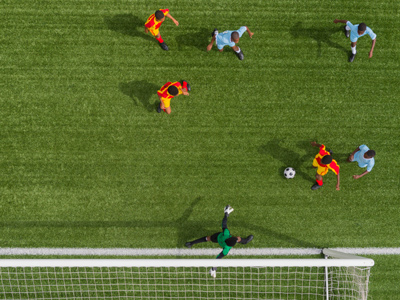
An international football pitch is 105m x 68m.
Level 3-4 Shapes - Perimeter and Area
Explore perimeter and area of rectangles, triangles, and compound shapes. Use formulas, units, and conversions to solve practical problems about fencing, flooring, and tiling.
1 .
Which of the following shapes would you not be asked to find the perimeter or area of?
Rectangle
Sphere
Trapezium
Triangle
A sphere is a 3 dimensional shape. Remember that perimeter and area are only associated with 2 dimensional shapes
2 .
What is the area of a square that has a length of 15 cm and a width of 16 cm?
225 cm2
256 cm2
240 cm2
Not a valid question
If the sides are different sizes then it cannot be a square!
3 .
A rectangle is 2 metres long and 88 centimetres wide; what is its area?
0.176 metres2
1.76 metres2
3.52 metres2
176 metres2
Don't mix up the metres and centimetres mentioned in the question
4 .
To calculate the area of a rectangle it is necessary to multiply the length by the width; how is this formula usually represented?
A = l x w
e = mc2
L = a/w
W = a/l
Area = length x width
5 .
Which of the following is not a valid measurement for an area?
102 m2
15 m
18 mm2
52 cm2
Area is always spoken of in terms of 'square' units i.e. 18 square millimetres or 52 square centimetres. In the answers above, 15 m is only a length
6 .
An international football pitch is 105 m x 68 m. What is the area of one half of the pitch?
3,570 metres2
4,624 metres2
7,140 metres2
11,025 metres2
105m x 68m = 7,140 metres2 so half the pitch's area is 7,140 metres2 ÷ 2 = 3,570 metres2
7 .
If a square has sides that are 13 cm long, what is its area?
26 cm2
52 cm2
105 cm2
169 cm2
13cm x 13cm = 169cm2
8 .
What is the area of a rectangle with a length of 9 cm and a width of 7 cm?
49 cm2
54 cm2
63 cm2
77 cm2
9 x 7 = 63
9 .
What is the perimeter of a rectangle with a length of 28 cm and a width of 16 cm
42 cm
64 cm
74 cm
88 cm
(28 x 2) + (16 x 2) = 56 + 32 = 88
10 .
A rectangle has a length that is twice its width. If the length is 18 m, what is its perimeter?
36 m
48 m
54 m
72 m
The width of the rectangle must be 9 m
Our Social Circles




**Unlimited Quizzes Await You! 🚀**
Hey there, quiz champ! 🌟 You've already tackled today's free questions.
Ready for more?
Ready for more?
🔓 Unlock UNLIMITED Quizzes and challenge yourself every day. But that's
not all...
not all...
🔥 As a Subscriber you can join our thrilling "Daily Streak" against other
quizzers. Try to win a coveted spot on our Hall of Fame Page.
quizzers. Try to win a coveted spot on our Hall of Fame Page.
Don't miss out! Join us now and keep the fun rolling. 🎉
**Unlimited Quizzes Await You! 🚀**
Hey there, quiz champ! 🌟 You've already tackled today's free questions. Ready for more?
🔓 Unlock UNLIMITED Quizzes and challenge yourself every day. But that's not all...
🔥 As a Subscriber you can join our thrilling "Daily Streak" against other quizzers. Try to win a coveted spot on our Hall of Fame Page.
Don't miss out! Join us now and keep the fun rolling. 🎉
© Copyright 2016-2026 - Education Quizzes
Work Innovate Ltd - Design | Development |
Marketing
