For Children
Return to a tricky question in their own time and ask the follow-up question they did not think of straight away.
LUCY AI TUTOR
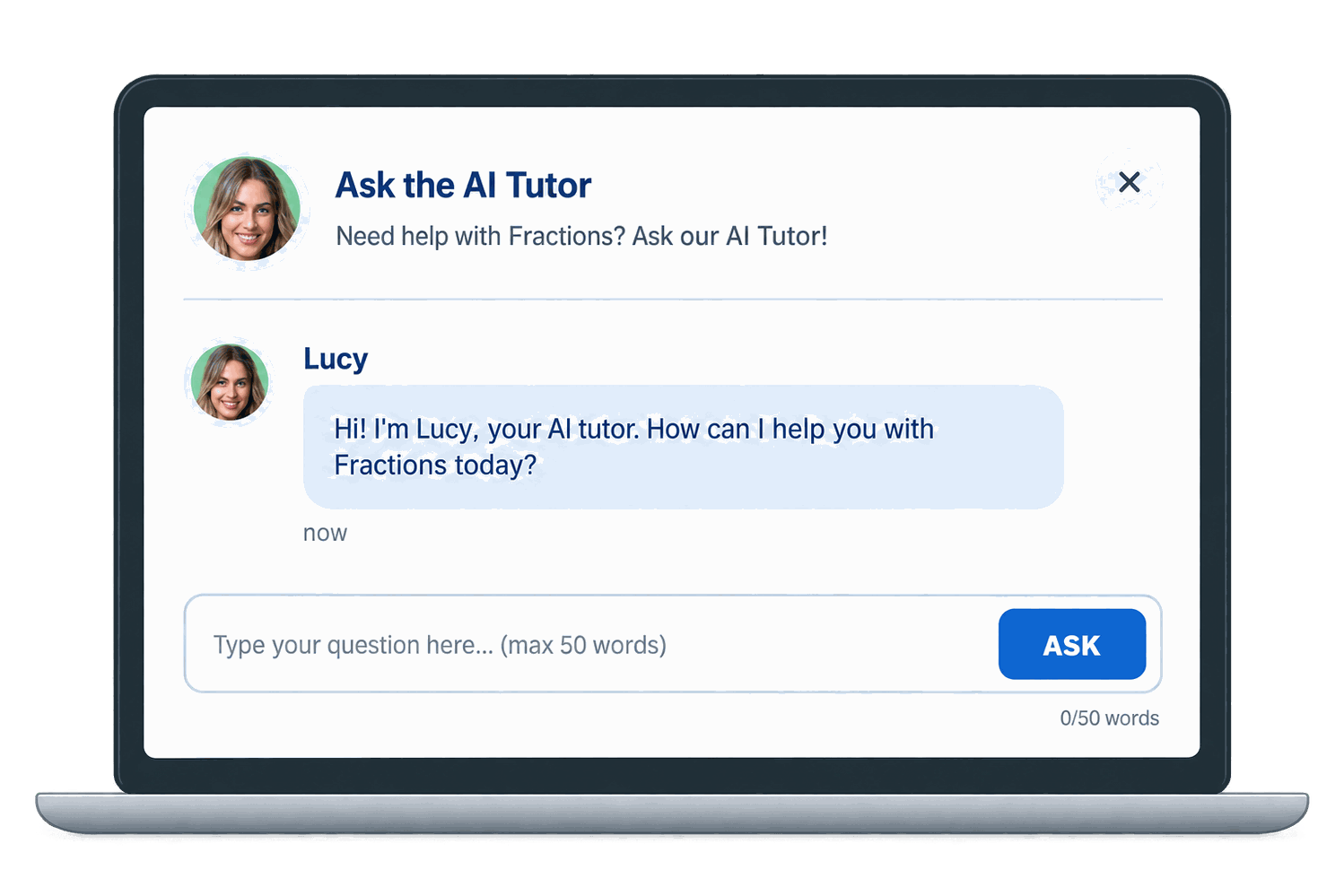
Sometimes a student needs a little extra help with quiz questions and answers. Lucy, our AI Tutor, comes to the rescue! This is especially useful when parents, teachers and tutors are not around to help.
The online tutor is designed specifically to help inquisitive young minds learn and remember. Lucy keeps conversations focused on the quiz topic, with filters to help keep responses age appropriate.
Account holders remain in control and can switch Lucy on or off whenever they choose.
START WITH A QUIZ QUESTION
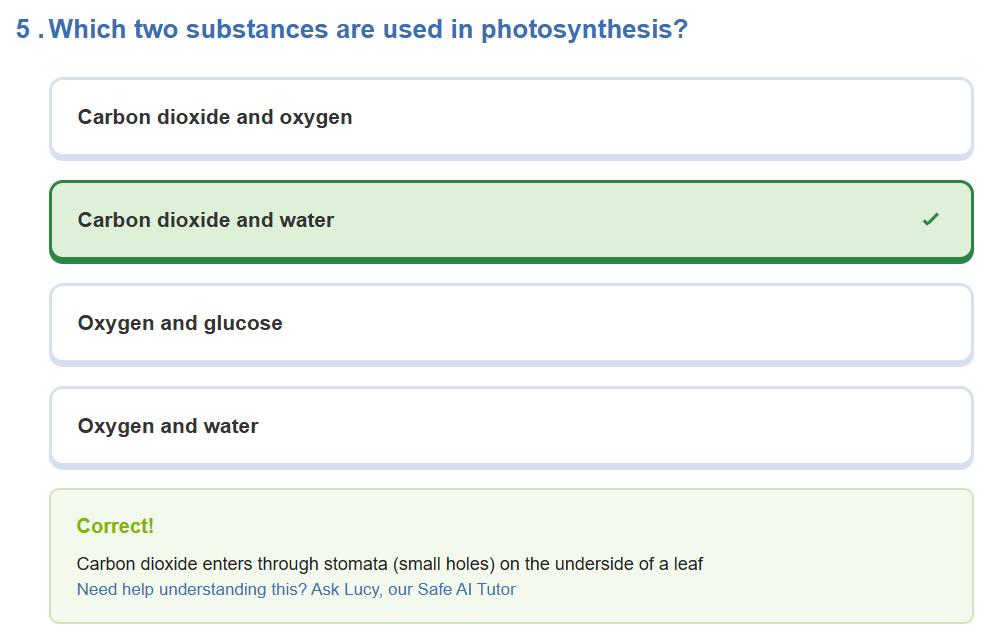
Our example begins with a real KS3 Science question about photosynthesis. When a student wants to understand more, Lucy offers different ways to explore that same topic.
In our example, the student has answered the question correctly but wants to delve a little deeper into the subject.
1EXPLAIN IT DIFFERENTLY
Not every explanation clicks first time. A student can ask Lucy to approach the same idea from another angle, perhaps by using simpler language, breaking it into smaller steps or giving a familiar example.
This helps the student work towards understanding the reasoning, rather than simply remembering which answer was correct.
I'm not sure I fully understand, can you explain it in a different way?
Photosynthesis is the process where plants use sunlight, water, and carbon dioxide to make glucose (sugar) and oxygen.
The Simple Recipe
What They Make
2REMEMBER IT
Sometimes students understand an answer but want help remembering it for next time. They can ask Lucy to organise important information in a way that makes it easier to recall.
It gives them something useful to take away from the quiz and try when they revisit the topic.
Is there an easy way to remember what goes into photosynthesis and what comes out?
Try remembering this: “Clever Dragons and Wizards make Great Omelettes” (Carbon Dioxide and Water make Glucose and Oxygen).
3ASK WHAT COMES NEXT
One question can spark another. If a student is curious about something in the answer, they can ask Lucy as many follow-on questions as they like - without fear of her getting angry or frustrated.
It is a chance for students to take an active role in their learning while keeping the conversation connected to what they are studying.
Are the leaves the only part of the plant that can photosynthesize?
Leaves are the primary site for photosynthesis in most plants because they contain chlorophyll, the pigment essential for capturing sunlight. However, green stems and unripened fruit can also carry out photosynthesis to a lesser extent. So while leaves are the main organs for photosynthesis, other green parts of the plant can also contribute to the process.
SWITCH ON OR OFF
Lucy is optional - if you don't like her, simply turn her off!

SUPPORT AROUND LEARNING
Lucy can be part of existing learning routines without replacing the people who guide and support children.
Return to a tricky question in their own time and ask the follow-up question they did not think of straight away.
Use an explanation as a starting point for talking through a difficult topic together.
Encourage learners to revisit a topic between sessions and bring any remaining questions back for discussion.
EXPLORE QUIZZES BY SUBJECT
Find quizzes by subject, then explore the school stages and topics available.
MORE WAYS TO LEARN
Lucy adds an extra explanation when it is needed. Explore the quizzes, reports, games and learning resources that work alongside her.
Explore curriculum-based questions, ten questions per quiz and teacher-written feedback to help learners understand their answers.
See Traffic Light results, find quizzes played previously and review completed work in dedicated reports.

Make revision more engaging with QuizMaster Solo or Team Play, using curriculum questions in game-style challenges.
Find reading colour filters, printable quizzes, useful links and other resources that complement learning.
COMMON QUESTIONS
Answers to common questions about Lucy, how she supports learning and the safeguards available to families.
Lucy is the optional AI Tutor from Education Quizzes. She works alongside teacher-written quizzes by giving learners another way to explore an answer or ask a follow-up question about the topic they are studying.
Lucy can explain the reasoning behind an answer in smaller steps or offer another example when the teacher-written feedback is not enough. The aim is to help children understand the idea, rather than simply give them the correct answer.
Yes. Account holders can choose whether Lucy is available to students and they can turn her on or off. Children can continue using Education Quizzes without Lucy.
No. Lucy is designed to keep conversations connected to the quiz topic being studied. Her topic-focused controls help keep assistance relevant.
Lucy uses topic-focused controls and filters intended to help keep replies age appropriate. These safeguards reduce risks but do not replace adult involvement or guarantee error-free responses.
Yes. Like other AI systems, Lucy can sometimes give an incorrect or confusing answer. Children should check anything uncertain with a parent, tutor or teacher, especially where an explanation is not understood.
No. Lucy is an additional learning aid but she plays second fiddle to parents, tutors and teachers! An AI is a useful supplement, not a replacement for people.
No. The example on this page is illustrative. It demonstrates the kind of step-by-step explanation Lucy may provide. Responses will always be helpful but may vary as AI becomes better and better.
Discover teacher-written quizzes with optional extra support from Lucy. Explore Education Quizzes through a trial or choose a subscription.
© Copyright 2016-2026 - Education Quizzes
Work Innovate Ltd - Design | Development |
Marketing