




Ask the AI Tutor
Need help with Earthquakes? Ask our AI Tutor!
AI Tutor - Lucy
Connecting with Tutor...
Please wait while we establish connection
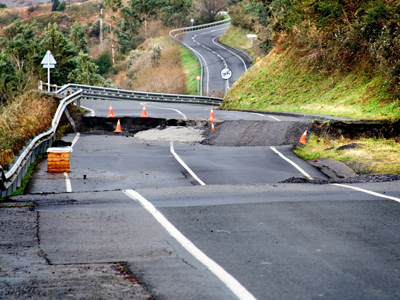
Have you ever felt an earthquake?
Earthquakes
Earthquakes shake the Earth’s crust when plates suddenly move. This GCSE Geography quiz helps you explore their causes, effects and how people try to stay safe.
1 .
Where do earthquakes mainly occur?
At the boundaries between plates
At the centre of plates
Under the sea
At the North and South Poles
They are mainly caused by plates moving against each other
2 .
The movement of the Earth's plates past one-another is ...
smooth
completely predictable
jerky
not known
There is a lot of friction between the rocks of the plates so they don't move smoothly past each other. This movement is unpredictable which is why earthquake forecasting is so difficult
3 .
On the following list, where is the deepest earthquake likely to occur?
In the UK
Somewhere along the San Andreas fault
The west coast of Peru
Impossible to say, the depth of an earthquake is random
You should be aware of the main examples of the different types of plate boundary. You should also know that deep earthquakes occur at destructive plate boundaries. The west coast of Peru is where you find a destructive plate boundary
4 .
Which one of the following explains why we have small earthquakes in Britain?
They are caused by small movements of old faults in the rocks
Britain is directly on a destructive plate boundary
There is a conservative plate boundary that runs from north to south down the middle of Britain
Britain is an island
Even though the faults were made millions of years in the past, the rocks on either side can still move a little, creating small earthquakes that are sometimes called earth tremors
5 .
When compared with a LEDC, during a large earthquake, the buildings in a city of a MEDC ...
will all collapse
will burst into flame
are less likely to be damaged
are more likely to suffer damage
MEDCs can afford to build earthquake resistant buildings
6 .
Which of the following is a secondary effect of an earthquake?
Ground shaking
Ground rupture
A tsunami
All of the above
Earthquakes cause the ground to shake and cracks can appear. Secondary effects are events that are triggered by an earthquake such as landslides, falling objects, fires and disease (water supplies are broken, so there is little or no clean water for hygiene and drinking)
7 .
Which of the following is not a reason why there is greater loss of life in a LEDC than a MEDC from an earthquake measuring 8 on the Richter scale?
The rescue services are less well equipped
Communications are better
Water supplies are cut
Buildings are weaker
There are many reasons why populations in LEDCs or less developed regions of MEDCs are hit harder - it usually comes down to a lack of money
8 .
Japan suffers from large earthquakes because ...
it is a small country
it is made up from several islands
it is split down the middle by a constructive plate boundary
it is right next to a destructive plate boundary
The Pacific plate is being destroyed under Japan
9 .
The point on the surface of the Earth, directly above where the earthquake originates is known as the ...
epicure
epicentre
epidermis
epipotamus
The point where the earthquake happened is known as the focus
10 .
The cause of an earthquake is ...
hot magma from the mantle moving upwards through the crust
water exploding because of the heat deep in the Earth's crust
shrinkage of the Earth
the release of strain that has built up in rocks at a plate boundary
There is a huge amount of friction between the plates which stops them moving smoothly



**Unlimited Quizzes Await You! 🚀**
Hey there, quiz champ! 🌟 You've already tackled today's free questions.
Ready for more?
Ready for more?
🔓 Unlock UNLIMITED Quizzes and challenge yourself every day. But that's
not all...
not all...
🔥 As a Subscriber you can join our thrilling "Daily Streak" against other
quizzers. Try to win a coveted spot on our Hall of Fame Page.
quizzers. Try to win a coveted spot on our Hall of Fame Page.
Don't miss out! Join us now and keep the fun rolling. 🎉
**Unlimited Quizzes Await You! 🚀**
Hey there, quiz champ! 🌟 You've already tackled today's free questions. Ready for more?
🔓 Unlock UNLIMITED Quizzes and challenge yourself every day. But that's not all...
🔥 As a Subscriber you can join our thrilling "Daily Streak" against other quizzers. Try to win a coveted spot on our Hall of Fame Page.
Don't miss out! Join us now and keep the fun rolling. 🎉




© Copyright 2016-2026 - Education Quizzes
Work Innovate Ltd - Design | Development |
Marketing
