




Ask the AI Tutor
Need help with USA: 1945-1975 - Land Of Freedom? US Society In The 1960s And 1970s? Ask our AI Tutor!
AI Tutor - Lucy
Connecting with Tutor...
Please wait while we establish connection
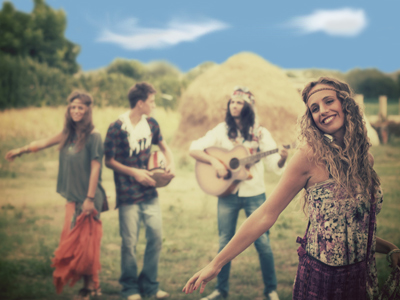
Hippies were a feature of 1960s society in America.
USA: 1945-1975 - Land Of Freedom? US Society In The 1960s And 1970s
This GCSE History quiz explores US society in the 1960s and 1970s, from civil rights and protest to changing attitudes about work, family, music and youth culture.
1 .
The musical apogee of the counterculture was said to be the 3 day pop music festival held in August 1969. What was the festival's name?
San Francisco
Woodstock
Rochester
Algonquin
1960s pop music was heavily influenced by folk music (Bob Dylan, Pete Seeger, Peter, Paul and Mary, etc.), while the 1970's saw the rise of punk and hard rock
2 .
In his inauguration speech of 1961 President John F. Kennedy evoked memories of the Nineteenth Century when he urged Americans to look to the future with optimism. What phrase did he use to suggest the pushing forward of boundaries?
A "New Frontier"
A "New Deal"
A "New Horizon"
A "New Hope"
Kennedy's rhetoric was inspirational, but within 3 years he was dead - the victim of an assassin's bullet
3 .
Hippies were a feature of the period. What name was given to a Hippie community, trying to live self-sufficiently?
Squat
Drop House
Commune
Hippy Shack
Many found self-sufficiency to be a difficult goal, but were sustained by drug use and their pacifist outlook, while the Vietnam War went on
4 .
President Johnson introduced a major series of measures in 1963 intended to help America's poor and to enable all to benefit from a federal health scheme. What was this programme called?
"A New Vision for America"
"The Big Deal"
"The Great Society"
"Great America"
Johnson hoped to carry on reform in the wake of his predecessor's death, but the continuance of the Vietnam War occupied much of his time and the nation's treasure
5 .
In which year did Nixon achieve a deal with the North Vietnamese, whereby he could agree to withdraw US combat troops at once?
1974
1975
1972
1973
The Paris accords allowed for a US withdrawal, leaving the South Vietnamese to carry on the struggle alone. Henry Kissinger, Nixon's envoy, and Le Duc Tho, for North Vietnam, received the Nobel Peace Prize for their role
6 .
Environmentalism was another enthusiasm of the period, encouraged by Rachel Carson's 1962 book, "Silent Spring". Later, at Three Mile Island in Pennsylvania, an incident occurred which led to many protests by activists. What happened there?
A nuclear power station exploded causing massive pollution
There was a leak of radioactive material into the river
Anti-nuclear protesters were poisoned, although they stayed well clear of the actual site
All people living within a 50 mile radius of the site were evacuated
Environmentalists alleged the inherent dangers of nuclear power, while conservatives pointed to the fact that no one had died in this incident
7 .
Student unrest was a feature of most of the decade. At which campus of the University of California did the "Free Speech Movement" emerge in 1964?
Santa Monica
San Pedro
Berkeley
Monterey
Unrest spread to other campuses across the United States, and was enflamed by the escalation of the Vietnam War
8 .
In 1978 the mandatory retirement age in the US was raised from 65. To what age was it now moved?
68
66
69
70
An increasingly ageing population forced the Federal Government to raise the age of retirement. The greater tax revenue from older workers might help to sustain more elderly people in their retirement
9 .
Richard Nixon, who was elected to the Presidency in 1968 and re-elected in 1972, sneered at protesters and praised those Americans who seemed satisfied with the "status quo", and were more inclined to vote for him. How did he refer to these latter citizens?
The "Silent Americans"
The "Silent Majority"
The "Loyal Majority"
"Middle America"
Nixon relied on these voters for his election and re-election. But his involvement in the Watergate scandal, and subsequent resignation, did not inspire confidence, and a Democrat (Jimmy Carter) replaced Gerald Ford (Nixon's Vice-President) in 1976
10 .
In 1970 President Nixon invaded Cambodia to try to prevent infiltration of communist forces from that country into South Vietnam. Protests erupted across the US, especially on university campuses. At which Ohio university campus were 4 students killed at one such protest?
Rutger's
Vassar
Brown
Kent State
The incident horrified US opinion, but very soon Nixon was negotiating with the North Vietnamese to seek an end to the war



**Unlimited Quizzes Await You! 🚀**
Hey there, quiz champ! 🌟 You've already tackled today's free questions.
Ready for more?
Ready for more?
🔓 Unlock UNLIMITED Quizzes and challenge yourself every day. But that's
not all...
not all...
🔥 As a Subscriber you can join our thrilling "Daily Streak" against other
quizzers. Try to win a coveted spot on our Hall of Fame Page.
quizzers. Try to win a coveted spot on our Hall of Fame Page.
Don't miss out! Join us now and keep the fun rolling. 🎉
**Unlimited Quizzes Await You! 🚀**
Hey there, quiz champ! 🌟 You've already tackled today's free questions. Ready for more?
🔓 Unlock UNLIMITED Quizzes and challenge yourself every day. But that's not all...
🔥 As a Subscriber you can join our thrilling "Daily Streak" against other quizzers. Try to win a coveted spot on our Hall of Fame Page.
Don't miss out! Join us now and keep the fun rolling. 🎉




© Copyright 2016-2026 - Education Quizzes
Work Innovate Ltd - Design | Development |
Marketing
