




Ask the AI Tutor
Need help with World War One: 1914-18 - Battles Of 1916 On The Western Front - 1? Ask our AI Tutor!
AI Tutor - Lucy
Connecting with Tutor...
Please wait while we establish connection
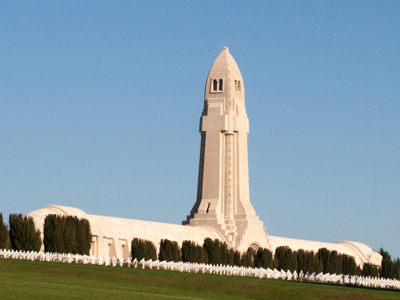
The Douaumont ossuary is a memorial to the French who died at Verdun.
World War One: 1914-18 - Battles Of 1916 On The Western Front - 1
Study the 1916 battles on the Western Front, including the Somme and Verdun, and discover why they became symbols of slaughter, stalemate and changing tactics.
1 .
Which member of the German royal family, the Hohenzollerns, commanded the German Fifth Army at Verdun?
The Crown Prince Wilhelm
Prince Georg of Hannover
Prince Ludwig of Hohenstaufen
Prince Karl of Wurttemberg
The royal prince had considerable military experience, and his appearance at Verdun was thought to be good for morale
2 .
Verdun was unusual among Great War battles in the comparative casualties on the two sides. What was odd about the comparable figures?
It was the only major campaign of the Great War in which the defenders suffered greater losses than the attackers
Large numbers of French troops surrendered, thus swelling the figures for captives, while few Germans became prisoners
There were large numbers of men classified as "missing" on the French side, of whom no trace was ever found. On the German side very few were given this classification
Far more German officers than French ones appeared in casualty lists
Verdun was a terrible killing machine. Survivors on both sides considered themselves "special"
3 .
Why was Falkenhayn, the German commander, prepared to commit so many troops to attacking French positions at Verdun?
He believed that German successes on the Eastern Front would enable him to put more and more troops into the Verdun salient
He thought that the French were so determined to hold Verdun that they would pour their reserves into the area. Thus, he believed, France would be eventually "bled white"
He was certain that French forces would soon be withdrawn from the Verdun theatre, in order to assist a forthcoming British attack further to the West
He knew that French morale was fragile after the failures of 1914 and 1915, and that further lack of success was bound to lead to mutinies
Falkenhayn seemed obsessed with Verdun
4 .
In the early stages of the battle a new French commander was appointed, whose catchphrase was "Ils ne passeront pas". Who was this general?
Petain
Weygand
Gamelin
Mangin
Both sides were prone to changing commanders if success proved elusive for too long
5 .
Apart from Fort Douaumont, which major fortress was lost and then recovered by the French?
Fort Vaux
Fort Bonaparte
Fort Estcourt
Fort Huysmans
The Verdun area was delineated by a complex of fortresses, of which two were especially significant
6 .
The road from Verdun to Bar-le-Duc was a vital supply lifeline for the French. What name was it given, indicating its importance?
La Voie Sacree
Le Chemin Saint
La Route de l'Espoir
Le Sentier de la Delivrance
Rapid re-supply was crucial for both sides. The French relied on this road, which was never cut by the enemy - despite almost continuous bombardment designed to interdict it
7 .
A new French commander was appointed on the 1st of May 1916, as Joffre and the French cabinet favoured a more aggressive approach. Whom did they choose?
Leclerc
Maginot
Nivelle
Carpentras
Commanding French forces at Verdun was an impossible task. No strategy seemed to work, and the Germans were determined to keep up the pressure
8 .
After the war the French erected a huge memorial at Fort Douaumont to commemorate their dead at Verdun. What form did this memorial take?
A list of names of the missing dead like the British memorial on the Somme
A collection of bones belonging to unidentified victims
A chapel of remembrance
A collection of poppies
The casualties at Verdun shattered the French. They were determined to construct a memorial that honoured appropriately the many thousands of French troops who gave their lives at Verdun
9 .
Falkenhayn was relieved of his position as Chief of Staff by the Kaiser towards the end of the campaign. Who replaced him?
Mackensen
Ludendorff
Hindenburg
Moltke
The Kaiser also felt that a more aggressive approach was needed
10 .
What is the significance of the Battle of Verdun in world history?
It was the longest battle ever
It was fought within the smallest area of any battle
It was the first battle when tanks were deployed
It was the first battle to see the use of poison gas
Verdun is ingrained in the French collective memory, but ultimately the German attack was called off



**Unlimited Quizzes Await You! 🚀**
Hey there, quiz champ! 🌟 You've already tackled today's free questions.
Ready for more?
Ready for more?
🔓 Unlock UNLIMITED Quizzes and challenge yourself every day. But that's
not all...
not all...
🔥 As a Subscriber you can join our thrilling "Daily Streak" against other
quizzers. Try to win a coveted spot on our Hall of Fame Page.
quizzers. Try to win a coveted spot on our Hall of Fame Page.
Don't miss out! Join us now and keep the fun rolling. 🎉
**Unlimited Quizzes Await You! 🚀**
Hey there, quiz champ! 🌟 You've already tackled today's free questions. Ready for more?
🔓 Unlock UNLIMITED Quizzes and challenge yourself every day. But that's not all...
🔥 As a Subscriber you can join our thrilling "Daily Streak" against other quizzers. Try to win a coveted spot on our Hall of Fame Page.
Don't miss out! Join us now and keep the fun rolling. 🎉




© Copyright 2016-2026 - Education Quizzes
Work Innovate Ltd - Design | Development |
Marketing
