




Ask the AI Tutor
Need help with GCSE Science Gap Finder? Ask our AI Tutor!
AI Tutor - Lucy
Connecting with Tutor...
Please wait while we establish connection

Pinpoint the gaps in your scientific knowledge and focus your revision for exam success.
GCSE Science Gap Finder
This GCSE Science diagnostic Gap-Finder quiz for Years 10–11 (ages 14–16) tests your understanding of Biology, Chemistry and Physics and highlights the areas to focus on next.
1 .
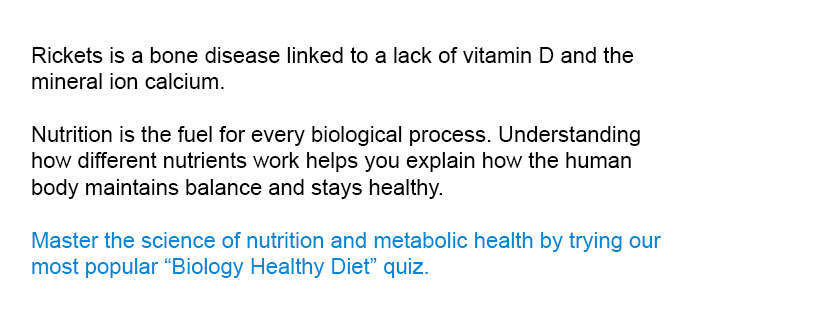
Which of the following health problems is not related to eating too many calories?
Heart disease
Rickets
Strokes
Diabetes
2 .
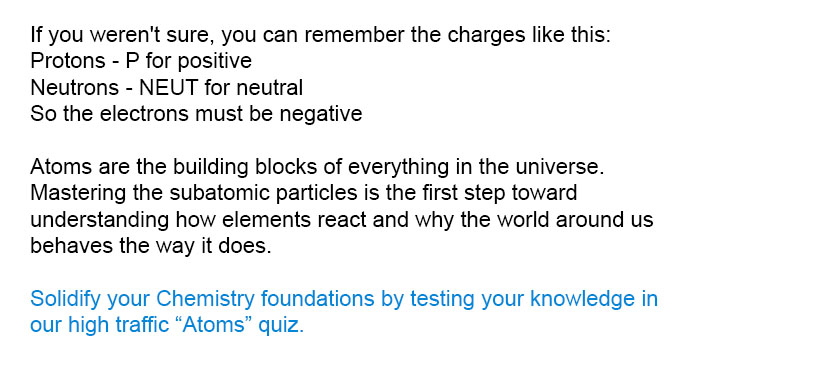
Which of the following give the charges in order for the proton, neutron and electron?
-1, +1, +1
0, +1, -1
+1, 0, -1
+1, +1, -1
3 .
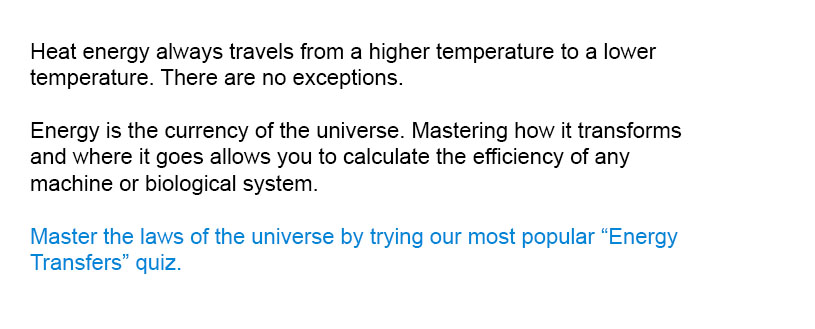
In which direction does thermal energy (heat) flow?
Cold to hot
Hot to cold
All directions
It depends on the exact situation
4 .
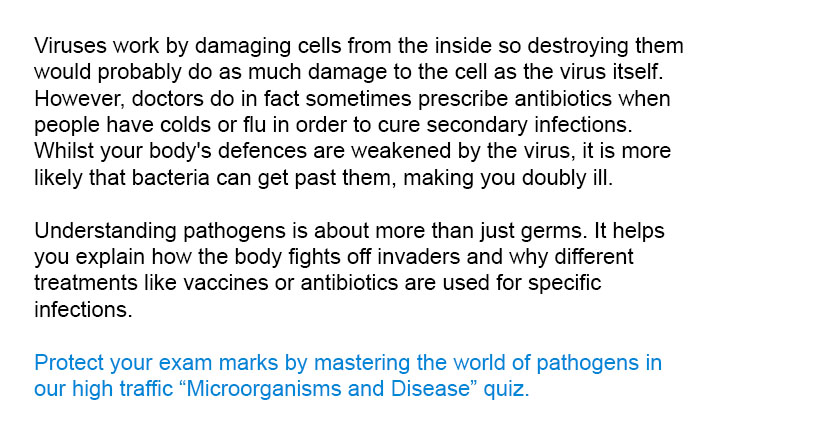
Why are antibiotics no good for treating colds and 'flu?
Colds and 'flu are viruses
Colds and 'flu are not viruses
Colds and 'flu are caused by bacteria that are resistant to antibiotics
Antibiotics work too slowly
5 .
How are the elements of the periodic table arranged?
They are arranged in descending order of atomic mass
They are arranged in ascending order of atomic mass
They are arranged in descending order of atomic number
They are arranged in ascending order of atomic number
6 .
"Particles with more energy move in to take the place of particles with less energy"
What method of heat transfer is being described in the previous sentence?
What method of heat transfer is being described in the previous sentence?
Sublimation
Conduction
Convection
Radiation
7 .
What process takes carbon dioxide from the air and makes it available to land living animals?
Photosynthesis
Respiration
Lightning strikes
Burning fossil fuels
8 .
When metals bond with non-metals what happens to their electrons?
The metals share their electrons
The metals gain electrons
The metals lose electrons
The metals keep the same number of electrons
9 .
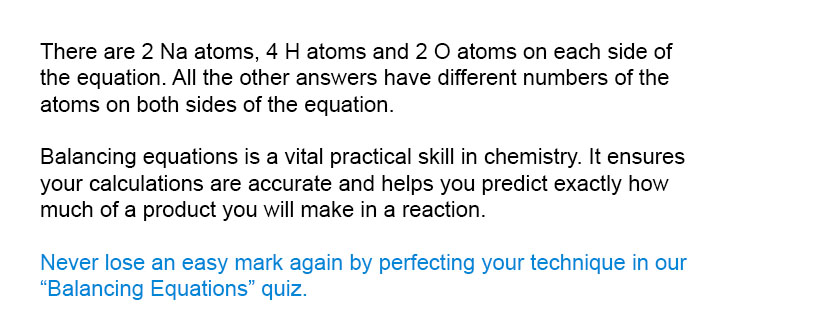
Balance the equation Na + H2O → NaOH + H2.
2Na + 2H2O → 2NaOH + H2
Na + 2H2O → NaOH + H2
2Na + H2O → 2NaOH + H2
2Na + 2H2O → 2NaOH + 2H2
10 .
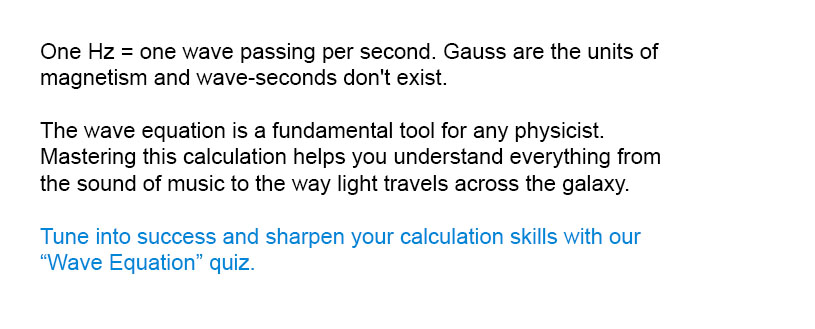
Wave frequency is measured in which unit?
Seconds
Wave-seconds
Gauss
Hertz
Our Social Circles




**Unlimited Quizzes Await You! 🚀**
Hey there, quiz champ! 🌟 You've already tackled today's free questions.
Ready for more?
Ready for more?
🔓 Unlock UNLIMITED Quizzes and challenge yourself every day. But that's
not all...
not all...
🔥 As a Subscriber you can join our thrilling "Daily Streak" against other
quizzers. Try to win a coveted spot on our Hall of Fame Page.
quizzers. Try to win a coveted spot on our Hall of Fame Page.
Don't miss out! Join us now and keep the fun rolling. 🎉
**Unlimited Quizzes Await You! 🚀**
Hey there, quiz champ! 🌟 You've already tackled today's free questions. Ready for more?
🔓 Unlock UNLIMITED Quizzes and challenge yourself every day. But that's not all...
🔥 As a Subscriber you can join our thrilling "Daily Streak" against other quizzers. Try to win a coveted spot on our Hall of Fame Page.
Don't miss out! Join us now and keep the fun rolling. 🎉
© Copyright 2016-2026 - Education Quizzes
Work Innovate Ltd - Design | Development |
Marketing
