




Ask the AI Tutor
Need help with Indus Valley? Ask our AI Tutor!
AI Tutor - Lucy
Connecting with Tutor...
Please wait while we establish connection
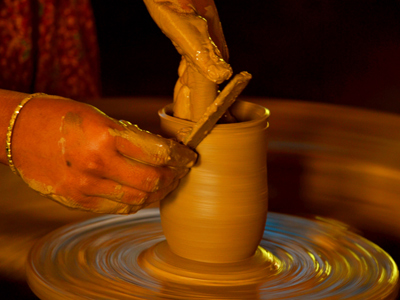
A potter's wheel was used to shape clay pots.
Indus Valley
Who lived in the Indus Valley? Explore ancient streets, busy markets, and carefully planned cities from one of the world’s earliest river civilisations.
1 .
Several thousands of what have been found with pictures and writing on them?
Scrolls
Tablets
Seals
Brooches
We don't know for sure what the seals were used for - mainly because we can't decipher the writing on them
2 .
Which of these did the Indus Valley people trade with?
Mesopotamians
Romans
Persians
Vikings
The Vikings, Romans and Persians were not around as early as the Indus Valley Civilisation was
3 .
What did the Indus Valley people use to shape clay pots?
Potter's wheels
Moulds
Knives
Drills
The potter's wheel was first used by the Indus Valley people around 3500 BC
4 .
What might an important Indus Valley man have worn?
Armour
A crown
A richly decorated cloak
A baseball cap
A statue was found in 1927, of a man with a fillet around his head, an armband, and a cloak decorated with patterns that were originally coloured red. This statue has been named the "Priest-King"
5 .
Which of these Indus cities is the biggest?
Harappa
Mohenjo-Daro
Banawali
Lothal
Mohenjo-Daro means Mound of the Dead in Sindhi, the local language
6 .
What can we learn from Indus Valley writing?
About their religion
About their battles and wars
About their kings
Nothing at all
No one is able to read the writing so it does not tell us anything
7 .
How many Indus Valley towns and cities have been found?
14
140
1,400
14,000
The Indus valley was 5 times larger than Britain
8 .
Where is the Indus Valley Civilisation found?
China
Iraq
Pakistan and parts of India
Egypt
The Indus river flows from the Himalayas to the Arabian Sea
9 .
Which modern day religion may have some similarities with the Indus Valley religion?
Islam
Hinduism
Buddhism
Christianity
A picture of a god found in the Indus valley shows a figure with a headdress, surrounded by animals. This is thought to be an early form of the Hindu god Shiva, who is the lord of animals
10 .
What was done before any houses were built in Indus cities?
The planting of crops
The building of a temple
The digging of wells and laying drains
The cutting down of trees
The ancient Indus drains were more advanced than any others in the world at the time. They were even better than some in Pakistan and India today



**Unlimited Quizzes Await You! 🚀**
Hey there, quiz champ! 🌟 You've already tackled today's free questions.
Ready for more?
Ready for more?
🔓 Unlock UNLIMITED Quizzes and challenge yourself every day. But that's
not all...
not all...
🔥 As a Subscriber you can join our thrilling "Daily Streak" against other
quizzers. Try to win a coveted spot on our Hall of Fame Page.
quizzers. Try to win a coveted spot on our Hall of Fame Page.
Don't miss out! Join us now and keep the fun rolling. 🎉
**Unlimited Quizzes Await You! 🚀**
Hey there, quiz champ! 🌟 You've already tackled today's free questions. Ready for more?
🔓 Unlock UNLIMITED Quizzes and challenge yourself every day. But that's not all...
🔥 As a Subscriber you can join our thrilling "Daily Streak" against other quizzers. Try to win a coveted spot on our Hall of Fame Page.
Don't miss out! Join us now and keep the fun rolling. 🎉




© Copyright 2016-2026 - Education Quizzes
Work Innovate Ltd - Design | Development |
Marketing
