




Ask the AI Tutor
Need help with Abstract Art? Ask our AI Tutor!
AI Tutor - Lucy
Connecting with Tutor...
Please wait while we establish connection
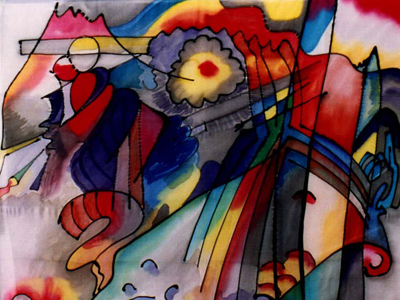
The above painting is by Wassily Kandinsky.
Abstract Art
Abstract art uses shape, colour, line, and texture to communicate ideas without always showing real objects. Learn the basics, then test your understanding in the quiz below.
1 .
Which of the following would you not expect to find in abstract art?
Composition
Tone
Realism
Imagery
Abstract art, by its very nature, has some degree of separation from realistic visual references
2 .
Which of the following movements did not contribute to early abstract art?
Pop Art
Romanticism
Impressionism
Expressionism
These three movements were the first to 'break away' from patronage from the church and rely instead on private patrons for funding
3 .
Which Eastern European religious philosophy had a profound impact on emerging abstract artists?
Monumentalism
Mellowism
Mausoleumism
Mysticism
Mysticism is a belief that deep contemplation may result in a better union with a deity
4 .
Paul Gauguin, Georges Seurat, Vincent van Gogh and Paul Cézanne had what in common?
They were neighbours
They were all taught at the same art school
They were all Post-Impressionists
They were all firmly opposed to abstract art
These four men had an enormous impact on 20th-century art that ultimately led to the advent of 20th-century abstraction
5 .
How did the the pre-Cubists, Georges Braque, André Derain, Raoul Dufy and Maurice de Vlaminck, revolutionise the Paris art world?
By refusing to paint using more than one colour
With "wild", multi-coloured, expressive landscapes and figure paintings
By producing up to 100 works each week
By painting the Eiffel Tower red
Art critics called this Fauvism, but the movement as such lasted only a few years and only had three exhibitions
6 .
Pablo Picasso made his first Cubist paintings based on whose idea that all depiction of nature can be reduced to three solid shapes?
Edvard Munch
Georges Seurat
Wassily Kandinsky
Paul Cézanne
Cézanne said these three shapes were the cube, sphere and cone
7 .
When Cubism emerged, it changed from one form to another. What were these forms called?
Decoded Cubism and Artificial Cubism
Thoughtful Cubism and Plastic Cubism
Decisive Cubism and Rounded Cubism
Analytic Cubism and Synthetic Cubism
Synthetic Cubism was distinctive due to the introduction of different textures, surfaces, collage elements, and a large variety of merged subject matter
8 .
The Bauhaus in Germany was a college created to bring unity to all art forms. What closed it?
The teaching staff
A student rebellion
The Nazi Party
The American President
The school was closed in 1933 after pressure from the Nazi government which claimed the Bauhaus was a centre of communist intellectualism
9 .
What other effect did the rise of the Nazi Party have on the main art movements at the time?
More abstract art came from America
Most abstract art was burnt or destroyed
Many artists joined the war effort
Most artists only painted tanks or aircraft
Many European artists fled to America and many art movements continued to develop and grow there
10 .
Which abstract artist was best known for his explosive, active painting and use of vibrant colour?
Claude Monet
Vincent Van Gogh
Jackson Pollock
Wassily Kandinsky
Franz Kline was also a renowned 'Action Painter'
Our Social Circles




**Unlimited Quizzes Await You! 🚀**
Hey there, quiz champ! 🌟 You've already tackled today's free questions.
Ready for more?
Ready for more?
🔓 Unlock UNLIMITED Quizzes and challenge yourself every day. But that's
not all...
not all...
🔥 As a Subscriber you can join our thrilling "Daily Streak" against other
quizzers. Try to win a coveted spot on our Hall of Fame Page.
quizzers. Try to win a coveted spot on our Hall of Fame Page.
Don't miss out! Join us now and keep the fun rolling. 🎉
**Unlimited Quizzes Await You! 🚀**
Hey there, quiz champ! 🌟 You've already tackled today's free questions. Ready for more?
🔓 Unlock UNLIMITED Quizzes and challenge yourself every day. But that's not all...
🔥 As a Subscriber you can join our thrilling "Daily Streak" against other quizzers. Try to win a coveted spot on our Hall of Fame Page.
Don't miss out! Join us now and keep the fun rolling. 🎉
© Copyright 2016-2026 - Education Quizzes
Work Innovate Ltd - Design | Development |
Marketing
