




Ask the AI Tutor
Need help with Food 02? Ask our AI Tutor!
AI Tutor - Lucy
Connecting with Tutor...
Please wait while we establish connection
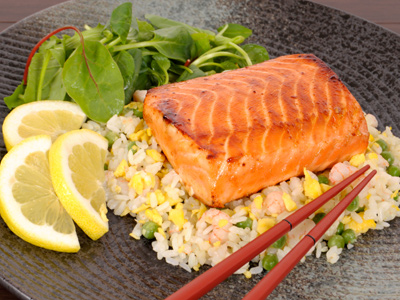
Food such as this grilled fish is high in protein.
Food 02
Explore how cooking choices affect flavour, texture, and safety. This KS3 Design and Technology quiz checks key food skills, from planning meals to using equipment correctly.
1 .
Which of these foods are high in protein?
Broccoli
Cabbage
Fish
Oranges
Alternative sources of protein are meat, nuts and quinoa
2 .
Grapefruits, oranges, lemons and limes are high in which vitamin?
A
B
C
D
A lack of vitamin C can lead to scurvy
3 .
Which of these might you use to bind together moist or slippery ingredients?
Breadcrumbs
Egg
Milk
Tomato puree
They absorb any liquid, turning soft and sticky, holding the mixture together
4 .
What would you use to remove lumps from powders?
Grater
Peeler
Rolling pin
Sieve
The fine holes in the sieve only allow the finest particles to go through
5 .
Jelly sets due to the gelatine absorbing water and the protein molecules forming a .......
gel
jel
mesh
net
Gelatine is made from animal bones, skins, cartilage and other body parts. Alternatives made from seaweed exist for those whose religion or diet (e.g vegans) prevent its use
6 .
Gelatine returns to a liquid if it is heated above .......
25oC
35oC
45oC
55oC
Jelly was popular in Victorian times but they didn't have fridges so it was quite difficult to keep it nice and jellified!
7 .
Which of the following technical words would describe jelly (or a solution of gelatine) as a liquid?
Gas
Liq
Sol
Wat
A sol is a mixture in which tiny particles of solid are spread through a liquid. It is different to an emulsion because a sol is stable and the particles don't ever settle out. Emulsions need an emulsifier to make them stable
8 .
Which of these is a way of preserving food?
Drying
Freezing
Pickling
All of the above
Canning, bottling and irradiation are also ways of preserving
9 .
How must the ingredients be listed on a food label?
From the healthiest to the least healthy
In alphabetical order
In ascending order of inclusion by weight
In descending order of inclusion by weight
If added water is more than 5% of contents, it must be listed as an ingredient. It is often listed as aqua to make it sound like a proper ingredient!
10 .
Additives must be shown by name and ....... number.
B
E
H
K
Each type of additive has its own range of E numbers e.g. colourings are E100 to E199



**Unlimited Quizzes Await You! 🚀**
Hey there, quiz champ! 🌟 You've already tackled today's free questions.
Ready for more?
Ready for more?
🔓 Unlock UNLIMITED Quizzes and challenge yourself every day. But that's
not all...
not all...
🔥 As a Subscriber you can join our thrilling "Daily Streak" against other
quizzers. Try to win a coveted spot on our Hall of Fame Page.
quizzers. Try to win a coveted spot on our Hall of Fame Page.
Don't miss out! Join us now and keep the fun rolling. 🎉
**Unlimited Quizzes Await You! 🚀**
Hey there, quiz champ! 🌟 You've already tackled today's free questions. Ready for more?
🔓 Unlock UNLIMITED Quizzes and challenge yourself every day. But that's not all...
🔥 As a Subscriber you can join our thrilling "Daily Streak" against other quizzers. Try to win a coveted spot on our Hall of Fame Page.
Don't miss out! Join us now and keep the fun rolling. 🎉




© Copyright 2016-2026 - Education Quizzes
Work Innovate Ltd - Design | Development |
Marketing
