




Ask the AI Tutor
Need help with Fictional Characters - Sherlock Holmes? Ask our AI Tutor!
AI Tutor - Lucy
Connecting with Tutor...
Please wait while we establish connection
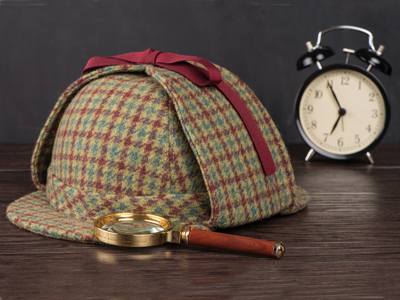
Try out your detective skills in this enjoyable quiz!
Fictional Characters - Sherlock Holmes
Step into Baker Street and test your knowledge of Sherlock Holmes, the brilliant fictional detective whose sharp mind, violin and pipe have fascinated readers for generations.
1 .
Dogs appear in all of the following cases but in which one did the famous ‘curious incident of the dog in the night-time’ occur?
The Hound of the Baskervilles
The Sign of Four
The Adventure of Silver Blaze
The Adventure of Shoscombe Old Place
2 .
Which of the following famous remarks was never made by Sherlock Holmes in Arthur Conan Doyle’s writings?
My name is Sherlock Holmes. It is my business to know what other people don’t know
I am the last and highest court of appeal in detection
Elementary, my dear Watson!
Data! Data! Data! I can’t make bricks without clay
These exact words never appear in Conan Doyle’s stories, only later in Sherlock Holmes films. Holmes comes near a few times. He says "Elementary" in 'The Crooked Man', and "It was very superficial, my dear Watson, I assure you" in 'The Cardboard Box'. He also says "Exactly, my dear Watson,” in three different stories
3 .
Who was Sherlock Holmes' infamous archenemy, the one he called ‘the Napoleon of Crime’?
Professor James Moriarty
Police Inspector Lestrade
Blackmailer Charles Augustus Milverton
Confidence trickster Henry “Holy” Peter
Conan Doyle lifted the phrase from a real-life Scotland Yard inspector referring to Adam Worth, a contemporary British criminal
4 .
In 1891, in ‘The Final Problem’, Sherlock Holmes sent ‘the Napoleon of Crime’ tumbling to his death in the boiling waters of the Reichenbach Falls. Holmes later claimed his resort to ‘Baritsu’ was the deciding factor in defeating his deadly foe. What was ‘baritsu’?
The same as ‘bartitsu’, a mix of martial arts and self-defence methods
A hypnotic glare of the eyes Holmes had picked up from his escapades in London’s China Town
A particular use of a lasso developed on the Argentine pampas to confound an attacking bull
A trick feigning unconsciousness until the moment is ripe to send an attacker flying
Bartitsu is a mix of martial arts and self-defence methods originally developed in England during the years 1898-1902 by Edward William Barton-Wright, a British engineer who had spent the previous three years living in the Empire of Japan. The word is a mix of his own surname and ‘Jujitsu’
5 .
Holmes’s elder brother Mycroft was a founder of a London club, ‘The Diogenes’. What was the strict rule which meant either membership refusal or subsequent loss of membership if broken?
Being discovered to be either of Prussian or Scottish descent, that is to say, tracing descent from a Prussian or Scottish father or mother, grandfather or grandmother
No member is permitted to take the least notice of any other one
No person be considered eligible who shall not have travelled out of the British islands to a distance of at least 500 miles in a direct line
Under no circumstances would any member campaign for women’s right to vote
The rule continued, ‘Save in the Stranger's Room, no talking is, under any circumstances, allowed, and three offences, if brought to the notice of the committee, render the talker liable to expulsion.’
The Club’s name seems to have been taken from Diogenes the Cynic (although this is never explained in the original stories) and was co-founded by Sherlock's indolent elder brother, Mycroft Holmes
The Club’s name seems to have been taken from Diogenes the Cynic (although this is never explained in the original stories) and was co-founded by Sherlock's indolent elder brother, Mycroft Holmes
6 .
In ‘The Adventure of the Speckled Band’, what does the evil Dr. Grimesby Roylott use to lure the ‘swamp adder’ (‘the deadliest snake in India’) back through the vent?
A ready supple of live laboratory rats, mice, frogs, toads, earthworms and slugs
A Capstan sea-shanty familiar to crews of Asia-bound square-rigged ships
A saucer of milk
The throbbing beat of the North India Pakhawaj drum
In fact snakes drinking milk is a complete myth. For the ‘swamp adder’ to be lured back to the other room, the evil Dr. Grimesby Roylott would most sensibly soak the fake bell-pull in rodent scent. ‘Speckled Band’ includes the memorable remark by Holmes: ‘When a doctor does go wrong, he is the first of criminals. He has the nerve and he has the knowledge.’
Conan Doyle should know what Holmes was talking about. He was himself a qualified medical doctor. Incidentally, there is no such snake as an Indian ‘swamp adder’ but the name does sound frightening
Conan Doyle should know what Holmes was talking about. He was himself a qualified medical doctor. Incidentally, there is no such snake as an Indian ‘swamp adder’ but the name does sound frightening
7 .
Which magazine turned Watson’s chronicles into rip-roaring best-sellers?
Punch Magazine
British Medical Journal
National Geographic
The Strand
The Strand was a monthly magazine composed of short fiction and general interest articles, published in London from January 1891 to March 1950. Its immediate popularity is shown by an initial sale of nearly 300,000 to a by-now highly literate population. Not many magazines can count Queen Victoria and Winston Churchill among their former contributors.
The Sherlock Holmes short stories were first published in The Strand with illustrations by Sidney Paget. When ‘A Scandal in Bohemia’ appeared in the July 1891 issue circulation rose immediately. The magazine also published a United States edition from February 1891 through February 1916. With the serialisation of Doyle's The Hound of the Baskervilles between August 1901 and April 1902, sales reached their peak. Without such an outlet, the Sherlock Holmes stories may never have gained their immense popularity
The Sherlock Holmes short stories were first published in The Strand with illustrations by Sidney Paget. When ‘A Scandal in Bohemia’ appeared in the July 1891 issue circulation rose immediately. The magazine also published a United States edition from February 1891 through February 1916. With the serialisation of Doyle's The Hound of the Baskervilles between August 1901 and April 1902, sales reached their peak. Without such an outlet, the Sherlock Holmes stories may never have gained their immense popularity
8 .
Holmes is an expert in hand-to-hand combat but also in weaponry. Of the following, which weapon does Holmes never employ?
Cane
Poison blow-darts
Sword
Pistols
Holmes never used a blowpipe although the weapon is employed against him in ‘The Sign Of The Four’ by Tonga, an Andaman islander
9 .
Conan Doyle wrote several ‘locked room’ mysteries where it seems impossible for the killer to have entered the room or left without being seen. Which one of the following four Sherlock Holmes is not a locked room mystery?
The Adventure Of The Speckled Band
The Valley of Fear
The Adventure of Wisteria Lodge
The Sign of the Four
The locked-room (or ‘impossible murder’) mystery is a category of detective fiction in which the victim is bludgeoned, stabbed, strangled, poisoned, or shot to death (i.e. almost always murdered) under circumstances in which it seems impossible for the perpetrator to evade detection getting in and away from the crime scene. The door is locked and bolted from the inside, there are no duplicate keys, and no spooky supernatural element. Typically there are no secret passages or hidden panels.
A classic example is Israel Zangwill’s ‘The Big Bow Mystery’ published in 1892. Mrs Drabdump's lodger is discovered with his throat cut. There is no trace of a murder weapon and no way a murderer could have got in or out. Another is ‘The Murders in the Rue Morgue’, a short story by Edgar Allan Poe published in Graham's Magazine in 1841. A woman and her daughter are murdered in an inaccessible room, locked from the inside. And John Dickson Carr’s ‘He Who Whispers’, in which the victim is stabbed to death in a closely guarded tower. Much further back, the Old Testament story ‘Bel And The Dragon’ has some similarities to locked-room mysteries
A classic example is Israel Zangwill’s ‘The Big Bow Mystery’ published in 1892. Mrs Drabdump's lodger is discovered with his throat cut. There is no trace of a murder weapon and no way a murderer could have got in or out. Another is ‘The Murders in the Rue Morgue’, a short story by Edgar Allan Poe published in Graham's Magazine in 1841. A woman and her daughter are murdered in an inaccessible room, locked from the inside. And John Dickson Carr’s ‘He Who Whispers’, in which the victim is stabbed to death in a closely guarded tower. Much further back, the Old Testament story ‘Bel And The Dragon’ has some similarities to locked-room mysteries
10 .
Originally Sherlock Holmes’s faithful chronicler Dr. John H. Watson planned to make a life-time career as a surgeon doctor in the British Army. Why then, in 1881, following a stint in Afghanistan, did he return to England?
His fiancée Mary Morstan refused to marry him unless he returned to civilian life
He received a telegram from Sherlock Holmes inviting him to become his chronicler
He was offered a lucrative medical practice in Paddington at a very favourable price
He got badly wounded by a jezail bullet at the Battle of Maiwand
He was discharged on a half pay officer’s pension of 11 shillings and 6 pence a month.
The jezail (or Jezzail, from Pashto) was a simple, often handmade muzzle-loading long arm then commonly used in British India, Central Asia and parts of the Middle East. Incidentally, some calculations (‘economic power’) give the modern value of Watson’s wound pension as Sterling £1,652, about the same as the average wage of a factory worker in Britain today
The jezail (or Jezzail, from Pashto) was a simple, often handmade muzzle-loading long arm then commonly used in British India, Central Asia and parts of the Middle East. Incidentally, some calculations (‘economic power’) give the modern value of Watson’s wound pension as Sterling £1,652, about the same as the average wage of a factory worker in Britain today



**Unlimited Quizzes Await You! 🚀**
Hey there, quiz champ! 🌟 You've already tackled today's free questions.
Ready for more?
Ready for more?
🔓 Unlock UNLIMITED Quizzes and challenge yourself every day. But that's
not all...
not all...
🔥 As a Subscriber you can join our thrilling "Daily Streak" against other
quizzers. Try to win a coveted spot on our Hall of Fame Page.
quizzers. Try to win a coveted spot on our Hall of Fame Page.
Don't miss out! Join us now and keep the fun rolling. 🎉
**Unlimited Quizzes Await You! 🚀**
Hey there, quiz champ! 🌟 You've already tackled today's free questions. Ready for more?
🔓 Unlock UNLIMITED Quizzes and challenge yourself every day. But that's not all...
🔥 As a Subscriber you can join our thrilling "Daily Streak" against other quizzers. Try to win a coveted spot on our Hall of Fame Page.
Don't miss out! Join us now and keep the fun rolling. 🎉




© Copyright 2016-2026 - Education Quizzes
Work Innovate Ltd - Design | Development |
Marketing

Gregory (Scotland Yard detective): "Is there any other point to which you would wish to draw my attention?"
Holmes: "To the curious incident of the dog in the night-time."
Gregory (bewildered): "The dog did nothing in the night-time."
Holmes: "That was the curious incident."