




Ask the AI Tutor
Need help with Coastal Scenery 02? Ask our AI Tutor!
AI Tutor - Lucy
Connecting with Tutor...
Please wait while we establish connection
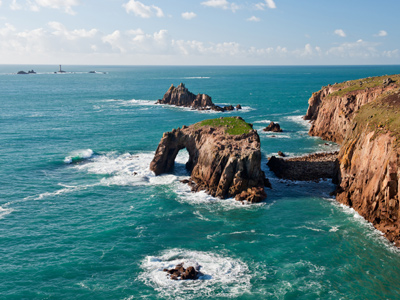
This is Land's End in Cornwall.
Coastal Scenery 02
At the coast, powerful waves attack cliffs using different erosion processes. This quiz explores hydraulic action and how it helps shape beaches, headlands, caves and arches.
1 .
A famous shingle bank in Dorset is Chesil what?
Beach
Heights
Ridge
Way
About 17 miles long - one of the longest storm beaches in Europe!
2 .
Headlands and bays are found in areas with what?
Alternating bands of hard and soft rock
Chalk rock only
Hard rock only
Soft rock only
Soft rock erodes to give bays; hard rock stands out as headlands
3 .
What causes the end of a sand spit to curve?
A change in wave and wind direction
An increase in wind strength
Larger grains of sand than usual
The activity of fish
A spit is created by longshore drift which is in turn created by the prevailing winds blowing on the coast. A prevailing wind is the most common wind direction, but wind can also arrive from other directions too. It is these secondary direction winds and the waves they create that can lead to the formation of a curve at the end of a spit
4 .
Waves throwing pebbles at a cliff leads to what process?
Abrasion
Corrosion
Saltation
Solution
The pebbles hammer at the cliff face and hollow out the base as a wave cut notch
5 .
What process leads to the formation of a sand spit?
Abrasion
Attrition
Hydraulic action
Longshore drift
They are long sand ridges growing out from a beach where the coastline suddenly changes direction - for example, Spurn Head in the estuary of the river Humber
6 .
The movement of a wave up a beach is called what?
Splosh
Squish
Swale
Swash
Swash adds material to the beach
7 .
Which wooden boards trap sand and stop beach erosion?
Gantries
Grilles
Groynes
Guardrails
They are set at right angles to the coastline
8 .
Rock extending further out to sea than the rocks on either side forms a what?
Cave
Headland
Stack
Wave cut platform
The rocks of a headland are usually a little more resistant to weathering and erosion than the rocks on either side
9 .
When the coastline is worn back it is said to have what?
Diminished
Retreated
Shrunk
Withered
Most of the coast of Britain is retreating
10 .
What name is given to large concrete blocks protecting the coast?
Sea break
Sea fence
Sea moat
Sea wall
Some sea walls are continuous and specially shaped to deflect the energy of the waves back out to sea. They are used to form the 'promenade' or 'esplanade' of seaside holiday towns to protect the town from storm damage



**Unlimited Quizzes Await You! 🚀**
Hey there, quiz champ! 🌟 You've already tackled today's free questions.
Ready for more?
Ready for more?
🔓 Unlock UNLIMITED Quizzes and challenge yourself every day. But that's
not all...
not all...
🔥 As a Subscriber you can join our thrilling "Daily Streak" against other
quizzers. Try to win a coveted spot on our Hall of Fame Page.
quizzers. Try to win a coveted spot on our Hall of Fame Page.
Don't miss out! Join us now and keep the fun rolling. 🎉
**Unlimited Quizzes Await You! 🚀**
Hey there, quiz champ! 🌟 You've already tackled today's free questions. Ready for more?
🔓 Unlock UNLIMITED Quizzes and challenge yourself every day. But that's not all...
🔥 As a Subscriber you can join our thrilling "Daily Streak" against other quizzers. Try to win a coveted spot on our Hall of Fame Page.
Don't miss out! Join us now and keep the fun rolling. 🎉




© Copyright 2016-2026 - Education Quizzes
Work Innovate Ltd - Design | Development |
Marketing
