




Ask the AI Tutor
Need help with River Landscapes 02? Ask our AI Tutor!
AI Tutor - Lucy
Connecting with Tutor...
Please wait while we establish connection
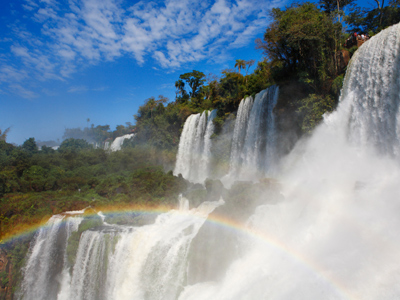
The base of a waterfall is called a plunge pool.
River Landscapes 02
Explore how rivers shape valleys, carve out channels and build landforms. This KS3 Geography quiz looks at erosion, transport and deposition along different parts of a river’s course.
1 .
What is the point where a river starts to flow?
Ketchup
Leak
Sauce
Source
A source is often a spring where water can be seen coming out of the ground. Sometimes the flow of a spring is very low and it is just a marshy spot on the hillside with a small stream trickling away from its lowest point
2 .
Which is not a way for water to run into a river?
Contraflow
Groundwater flow
Surface runoff
Throughflow
Contraflow is a way of controlling road traffic!
3 .
What type of lakes are the remains of old meanders?
Longbow
Ox-bow
Remnant
Ribbon
Formed if the meander is cut off from the main river when the river flow rate is high e.g. during a flood
4 .
Some river mouths have what feature?
Delta
Glacier
Gorge
Rapids
Low-lying land formed from deposited material
5 .
What is the correct term for the bottom of a river channel?
Base
Bed
Bum
Bunk
The bed of a river in its early stages is usually rocky but in its final stages near its mouth, the river bed is usually mud
6 .
Which of the following can be formed by both deposition and erosion?
Levee
Ox-bow lake
V-shaped valley
Waterfall
The river erodes a meander, which becomes more and more 'horseshoe' shaped. As the two ends of the 'horseshoe' meet, the river can break through, cutting off the meander from the flow of the river. Silt is then deposited at the ends of the meander as the flow is slower, creating the ox-bow lake
7 .
A river deposit of very fertile material is called what?
Alluvium
Cap rock
Load
Moraine
Alluvial soil makes good farmland
8 .
The area drained by a river is the drainage…what?
Basin
Bowl
Plateau
Reservoir
Some river basins can be huge
9 .
Where would a plunge pool be found?
At the base of a waterfall
In a delta
Near the source
On a flood plain
It is an area where erosion is high and is situated where the water coming over the waterfall lands
10 .
High land separating two drainage basins has what name?
Border fell
Drainage spur
Watermark
Watershed
Two rivers can have their sources only a few metres apart but if they are on opposite sides of a watershed, their mouths could be hundreds of kilometers apart



**Unlimited Quizzes Await You! 🚀**
Hey there, quiz champ! 🌟 You've already tackled today's free questions.
Ready for more?
Ready for more?
🔓 Unlock UNLIMITED Quizzes and challenge yourself every day. But that's
not all...
not all...
🔥 As a Subscriber you can join our thrilling "Daily Streak" against other
quizzers. Try to win a coveted spot on our Hall of Fame Page.
quizzers. Try to win a coveted spot on our Hall of Fame Page.
Don't miss out! Join us now and keep the fun rolling. 🎉
**Unlimited Quizzes Await You! 🚀**
Hey there, quiz champ! 🌟 You've already tackled today's free questions. Ready for more?
🔓 Unlock UNLIMITED Quizzes and challenge yourself every day. But that's not all...
🔥 As a Subscriber you can join our thrilling "Daily Streak" against other quizzers. Try to win a coveted spot on our Hall of Fame Page.
Don't miss out! Join us now and keep the fun rolling. 🎉




© Copyright 2016-2026 - Education Quizzes
Work Innovate Ltd - Design | Development |
Marketing
