




Ask the AI Tutor
Need help with Artists' Materials? Ask our AI Tutor!
AI Tutor - Lucy
Connecting with Tutor...
Please wait while we establish connection
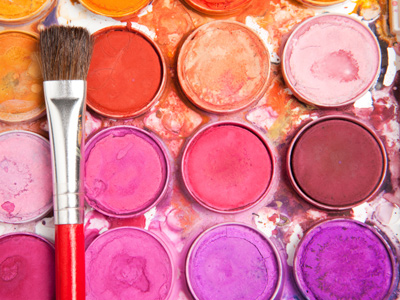
Perhaps the most important of an artists materials - his paints.
Artists' Materials
Explore the materials artists use to create artworks, from pencils and paint to clay and stone. Learn how different materials affect texture, colour, and the finished look.
1 .
A new type of paint, which is water soluble when wet but water resistant when dry, became popular in the 20th century. What is it called?
Eggshell paint
Acrylic paint
Poster paint
Satin paint
Acrylic paint can be diluted with water to the required thickness before application, and it dries quickly, is durable and has vivid colours. These attributes made it attractive to some modern artists such as David Hockney and Andy Warhol
2 .
Until it was replaced by canvas in the 16th century, what was the most common material for an artist to paint on?
Wood
Paper
Card
Cotton
Paintings on wooden backgrounds, or 'Panel Paintings' as they were known, were popular from the time of the ancient Greeks up until the 17th century. They did not die out completely though. The Spanish painter Goya was still painting onto panels in the 19th century
3 .
To protect paintings which are not going to be framed beneath glass, a final coat is often added. What type of material is this final coat?
Turpentine
Gloss paint
Egg white
Varnish
Turpentine would destroy the painting and gloss paint would obscure it! Clear varnish helps to protect the painting from the damaging effects of the environment.
I'm not sure what effect egg white would have on a painting, so I wouldn't recommend using it!
I'm not sure what effect egg white would have on a painting, so I wouldn't recommend using it!
4 .
Canvas has been the most popular form of support for oil paintings for over 400 years. Today it is usually made from cotton or linen but the original canvas material was made from what?
Hemp
Wool
Flax
Goat skin
The word canvas can trace its origins to the Latin cannapaceus meaning 'made of hemp'.
Ironically, oil paint will cause the fibres on a sheet of canvas to decay so, prior to painting, the material is coated with gesso (a mixture of chalk and gypsum bound together) to protect the canvas
Ironically, oil paint will cause the fibres on a sheet of canvas to decay so, prior to painting, the material is coated with gesso (a mixture of chalk and gypsum bound together) to protect the canvas
5 .
What is the technique of mural painting in which a water based pigment is painted on to fresh plaster?
Gecko
Secco
Tesco
Fresco
The Italian word fresco means 'fresh' in English, and frescos were so called because they were painted onto fresh plaster. When the plaster dried the painting became an integral part of the wall.
Seccos (meaning 'dry') were another type of mural in which paint was applied to dry walls.
Gecko and Tesco are not murals at all, but a species of lizard and a chain of shops!
Seccos (meaning 'dry') were another type of mural in which paint was applied to dry walls.
Gecko and Tesco are not murals at all, but a species of lizard and a chain of shops!
6 .
Just as wooden panel supports were superseded by canvas ones, which type of paint became obsolete when oils were developed?
Woad
Gouache
Egg Tempera
Bone Palampore
Egg tempera is a type of paint which uses egg yolk to bind the pigment together. It is not very flexible and needs to be painted onto a hard support such as wood.
The development of the more durable oil paint, together with canvas supports, rendered egg tempura obsolete. It has, however, enjoyed a couple of revival periods. The British artist William Blake was known to use it, and there was a surge in popularity during the 20th century. Some artists are still using egg tempura today, though they are in the minority
The development of the more durable oil paint, together with canvas supports, rendered egg tempura obsolete. It has, however, enjoyed a couple of revival periods. The British artist William Blake was known to use it, and there was a surge in popularity during the 20th century. Some artists are still using egg tempura today, though they are in the minority
7 .
Prior to application, paints are made into liquids by the addition of a solvent. Two examples of solvents are turpentine and white spirit, but what is the most commonly used type of solvent amongst artists?
Water
Toluene
Acetone
Methyl acetate
Water is by far the most common solvent artists use. Most kinds of paint, such as watercolour, tempera and acrylic, are water soluble. Only the oil based paints require a stronger solvent than water
8 .
What is the name of the technique in which a brush full of solvent is loaded with diluted paint and then applied to a support which is also covered in solvent? This method should create a semi-transparent, uniformly coloured area with no brush strokes, if it is done correctly.
A shine
A wash
A glaze
A soak
This technique is most often seen in watercolour where it is used to provide a background for ink drawings. It is possible with oil based paints, although the brush and support would have to be soaked in turpentine or white spirit rather than water to get the same effect
9 .
Oil paints are made by binding pigments together with a kind of oil. Which of these oils have been used in oil paints?
Poppy seed oil
Linseed oil
Walnut oil
All of the above
Different types of oil give different qualities to the paints, for example, longer or shorter drying times, or less susceptibility to discolouration.
Recently emulsifiers have been added to oil paints, decreasing their drying time and ending the reliance on paint thinners such as turpentine
Recently emulsifiers have been added to oil paints, decreasing their drying time and ending the reliance on paint thinners such as turpentine
10 .
Watercolour may be the oldest kind of paint, possibly dating back to prehistoric cave paintings and certainly in use by the ancient Egyptians. But why is it called 'watercolour'?
Because water is used to make the paint
Because the paint is great for painting lakes and rivers
Because the paint is water soluble
Because the paint flows like water
Watercolours use water soluble binders to hold the pigment together. When water is introduced the binder dissolves and the pigment mixes with the water to create the liquid paint. Although it can be used to paint great pictures of lakes and rivers, that is not how it got its name!



**Unlimited Quizzes Await You! 🚀**
Hey there, quiz champ! 🌟 You've already tackled today's free questions.
Ready for more?
Ready for more?
🔓 Unlock UNLIMITED Quizzes and challenge yourself every day. But that's
not all...
not all...
🔥 As a Subscriber you can join our thrilling "Daily Streak" against other
quizzers. Try to win a coveted spot on our Hall of Fame Page.
quizzers. Try to win a coveted spot on our Hall of Fame Page.
Don't miss out! Join us now and keep the fun rolling. 🎉
**Unlimited Quizzes Await You! 🚀**
Hey there, quiz champ! 🌟 You've already tackled today's free questions. Ready for more?
🔓 Unlock UNLIMITED Quizzes and challenge yourself every day. But that's not all...
🔥 As a Subscriber you can join our thrilling "Daily Streak" against other quizzers. Try to win a coveted spot on our Hall of Fame Page.
Don't miss out! Join us now and keep the fun rolling. 🎉




© Copyright 2016-2026 - Education Quizzes
Work Innovate Ltd - Design | Development |
Marketing
