




Ask the AI Tutor
Need help with The Overture 01? Ask our AI Tutor!
AI Tutor - Lucy
Connecting with Tutor...
Please wait while we establish connection
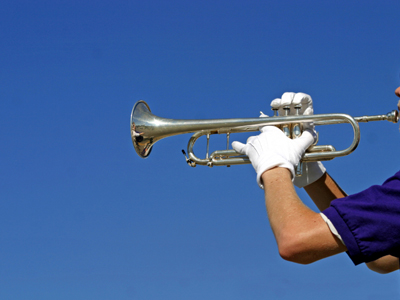
A fanfare is a short piece of ceremonial music often played by brass.
The Overture 01
Overtures set the mood and introduce key musical ideas. In this KS3 Music quiz, explore how composers use tempo, themes, and instruments to grab attention from the start.
1 .
What is the literal meaning of 'overture'?
Closing
Middle-section
Opening
Pause section
From the French word 'ouverture'
2 .
In that case, what is an overture?
An instrumental introduction to a large piece of music
A type of solo tenor aria
A 4-part chorale
None of the above
Strictly speaking, the instrumental introduction to large-scale dramatic, choral or sometimes instrumental compositions
3 .
When was the overture particularly prominent?
From the early 'Romantic' era
In 21st century compositions
In early music of the 1500s
It was never that popular amongst composers
Although symptoms of the overture are noticeable in music by C. Monteverdi (17th century)
4 .
Which of these are 'Romantic' composers?
Ludwig Van Beethoven
Carl Maria Von Weber
Franz Schubert
All of the above
The romantic era lasted from the late 18th to the early 20th Century
5 .
What different types of music feature overtures?
Operas
Musicals
20th century films
All of the above
The overture was particularly common in mid-20th century films and is often still used today
6 .
What is a particular characteristic of overtures?
They are often very quiet
They are played at the end of a concert
They aren't very long
They show a series of different and representative themes
For example in a musical or opera, those themes may represent characters or highlight a particular song
7 .
What is a transition?
A quiet 4-bar section between themes
A fast movement played in a large piece
A dividing musical section between main themes
None of the above
Often used in pieces with a sonta form structure
8 .
A 'pivot' chord is best described as .......
a loud chord
a quiet chord
a slow chord often played as an arpeggio
a transition chord between one key signature to the next
A pivot is a central point joining two parts (think of the centre of a seesaw) so a pivot chord joins two signatures
9 .
What best describes a fanfare?
A type of crowd chant at rock concerts
A short piece of ceremonial music often played by brass
A type of guitar solo usually played by fans' request
None of the above
Often accompanied by percussion
10 .
Which of the following wrote overtures?
Shostakovich
Brahms
R. Schumann
All of the above
Beethoven, Berlioz, Elgar, Mendelssohn, Mozart, Rossini, Tchaikovsky, Wagner and many other composers also dabbled with overtures



**Unlimited Quizzes Await You! 🚀**
Hey there, quiz champ! 🌟 You've already tackled today's free questions.
Ready for more?
Ready for more?
🔓 Unlock UNLIMITED Quizzes and challenge yourself every day. But that's
not all...
not all...
🔥 As a Subscriber you can join our thrilling "Daily Streak" against other
quizzers. Try to win a coveted spot on our Hall of Fame Page.
quizzers. Try to win a coveted spot on our Hall of Fame Page.
Don't miss out! Join us now and keep the fun rolling. 🎉
**Unlimited Quizzes Await You! 🚀**
Hey there, quiz champ! 🌟 You've already tackled today's free questions. Ready for more?
🔓 Unlock UNLIMITED Quizzes and challenge yourself every day. But that's not all...
🔥 As a Subscriber you can join our thrilling "Daily Streak" against other quizzers. Try to win a coveted spot on our Hall of Fame Page.
Don't miss out! Join us now and keep the fun rolling. 🎉




© Copyright 2016-2026 - Education Quizzes
Work Innovate Ltd - Design | Development |
Marketing
